
AC & Evaporative Cooler Leak Water Damage in Chandler, AZ
An air conditioner running hard through an Arizona summer makes a lot of water. When the drain clogs or a rooftop cooler overflows, that water ends up in the ceiling. Here's what to check, and how to get free quotes from independent restoration companies.
Get a Free Quote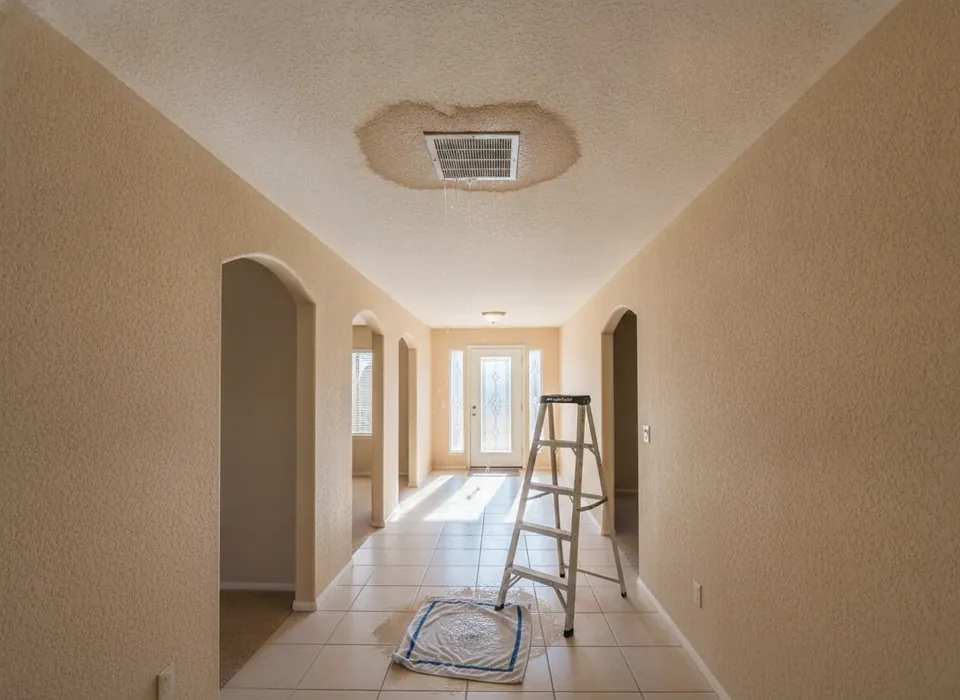
What happens first
Turn the AC off at the thermostat. It sounds harsh in July, but every hour it runs with a blocked drain sends more water into the ceiling. If the stain is near a light fixture, switch that circuit off at the breaker. Put a towel and bucket under any drip.
If you can safely reach the attic, look at the air handler's drain pan with a flashlight. Don't walk on the ceiling drywall between joists. Photograph the stain, the pan and the unit's label. Then call an HVAC technician for the unit and Call (727) 300-6656 or the form below for the water damage.
How attic AC systems leak
Many Valley homes have the air handler, the indoor half of a split system, in the attic above the ceiling. As it cools, it pulls water out of the air. That condensate drips into a primary pan and runs out a drain line. Most attic installs also have a secondary or emergency pan underneath as a backup.
- Clogged condensate lines. Algae, dust and hard-water scale build up in the line, a common Phoenix-area cause of ceiling stains, according to local HVAC and restoration companies.
- Full or rusted secondary pans. Old metal pans corrode through, or fill and spill over the edge.
- Failed or missing float switches. A float switch is meant to shut the system off when the pan fills. If it's missing, stuck or disconnected, the AC keeps running and the pan overflows.
- More water in monsoon season. Higher humidity means the air handler makes more condensate, so a line that kept up in June can overflow in August.
- Duct and boot sweating. Poorly sealed ducts in a hot attic can drip around ceiling grilles, which looks like a leak but needs a different fix.
Evaporative cooler roof leaks
Evaporative or "swamp" coolers sit on the roof and keep a reservoir of water. Some older East Valley homes still run them. HVAC sources note that their float valves tend to fail open, so the reservoir keeps filling and overflows onto the roof. That water, often heavy with mineral scale from Chandler's hard water, finds its way around the roof jack and the duct boot where the cooler connects to the house. Those seals crack in the summer heat.
The damage shows up inside as a stain around the cooler's ceiling vent, or as a leak that appears in dry weather, which rules out rain. If you see that, shut off the water supply line to the cooler and have it serviced. A cooler that's no longer used should have its water line capped and the roof opening properly sealed.
If the leak only happens during storms, the cause may be a roof penetration rather than the cooler itself. See monsoon roof leaks and ceiling damage.
What restoration companies do after an AC leak
The HVAC technician repairs the drain, pan or float switch; the restoration company handles the wet ceiling and anything below it.
Check the attic
Wet insulation around the air handler is removed or dried, and the top of the ceiling drywall is checked with a meter.
Judge the ceiling
Firm drywall with a small stain can often be dried in place and sealed. Sagging, soft or crumbling sections are cut out. In older homes, test popcorn texture for asbestos before it's disturbed.
Dry what's below
Water that dripped onto carpet, tile or furniture is extracted and dried. Drying equipment runs in the room and sometimes the attic.
Repair and refinish
Patching, texture matching and paint are done by an ROC-licensed contractor once readings confirm the ceiling is dry.
What AC leak repairs typically cost
Ceiling repair after a leak typically runs $325–$1,100, depending on the size of the patch and how hard the texture is to match. AC condensate is usually treated as gray water, with extraction at about $4.10–$6.50 per square foot if it reached the floor. If a slow overflow ran long enough for mold to grow on the drywall or insulation, remediation typically adds $1,500–$4,000. HVAC repairs to the drain, pan or float switch are billed separately. Typical ranges from national cost guides (Fixr 2025, HomeAdvisor 2025); East Valley quotes vary. See the cost guide.
Insurance for AC and cooler leaks
A sudden overflow found right away is more likely to be covered than a slow drip that stained the ceiling over months, which insurers often call maintenance. The AC repair itself is usually your expense. Photograph the pan, the line and the ceiling, keep the HVAC technician's notes on what failed, and ask your adjuster. Your policy's deductible applies. More in the Arizona claims guide.
When it's urgent
- The ceiling is sagging, or water is dripping near a light or smoke detector.
- The stain is growing even with the AC off, which points to another source.
- Insulation in the attic is soaked over a large area.
- You smell mustiness from the vents. See mold after water damage.
AC and evaporative cooler leak FAQ
Why is water coming out of my AC vent or around the grille?
Usually the condensate drain from the attic air handler is clogged and the pan is overflowing onto the ceiling drywall near the grille. It can also be a sweating duct or boot in a hot attic. Turn the system off, check the pan if you can safely reach it, and have an HVAC technician clear the line and check the float switch.
What is an AC float switch?
A float switch is a small safety device in the drain pan or drain line. When water rises because the line is blocked, the float lifts and shuts the AC off before the pan overflows. If your system has none, or it's stuck or bypassed, a clog can flood the ceiling. Ask your HVAC technician to test it at each service.
Can a stained ceiling from an AC leak be painted over?
Only after the leak is fixed and the drywall is confirmed dry with a meter. A firm, lightly stained ceiling can often be sealed with a stain-blocking primer and repainted. Painting over wet drywall traps moisture and can lead to mold. Sagging or soft sections should be replaced rather than painted.
Does my swamp cooler cause roof leaks?
It can. Evaporative cooler float valves can fail open and overflow onto the roof, and the seals around the roof jack and duct boot crack in the heat. A ceiling stain near the cooler vent that shows up in dry weather points to the cooler. Shut off its water line and have it serviced, or properly capped if unused.
Get free quotes for AC or cooler leak damage
Tell the companies where the ceiling is stained, whether the AC or cooler has been repaired, and whether water reached the floor. Independent East Valley restoration companies reply with quotes.
Water where it shouldn't be? Get free quotes.
Tell us what happened and independent East Valley restoration companies can reply with no-obligation quotes.