
Mold After Water Damage in Chandler, AZ
Desert air doesn't stop mold when water sits in a wall or under a sink. Here's how mold after water damage gets handled in the East Valley, what it typically costs, and how to get free quotes from independent companies.
Get a Free Quote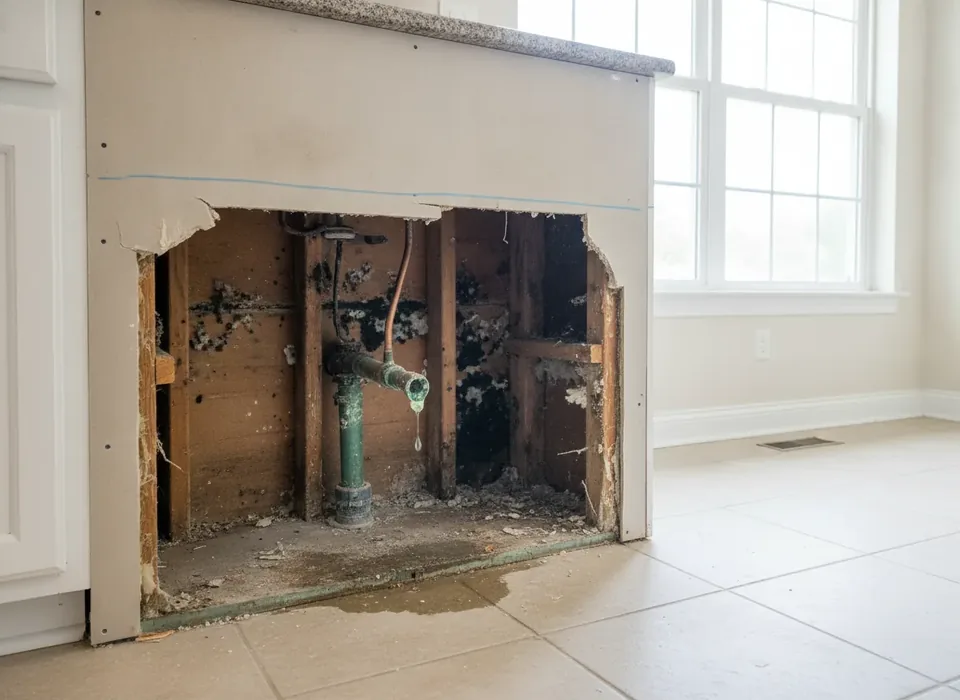
What happens first
Fix the water. Mold needs moisture, so the first step is finding and stopping the leak behind it: a drip under the sink, a slow toilet seal, an AC drain pan, or a slab leak. Mold can start within 24–48 hours after materials get wet, so a leak that ran for a week is a likely mold job.
Don't scrub or sand visible growth, and don't run a fan that blows across it; both spread spores. Close the cabinet or door, photograph what you see, and call Call (727) 300-6656 or send the form. If anyone has breathing trouble, headaches or allergy symptoms they link to the house, see a doctor.
Where mold shows up in Chandler homes
The places are predictable, and most are hidden:
- Under kitchen and bathroom sinks, where a slow drip from a supply line or drain soaks the cabinet floor and the wall behind it.
- Behind washers and refrigerators, from hoses and ice-maker lines.
- Around attic air handlers, where an overflowing condensate pan wets ceiling drywall from above. See AC and evaporative cooler leaks.
- Baseboards and tack strip over a slab leak that ran for weeks before anyone noticed.
- Ceilings below monsoon roof leaks, where wet insulation held water against drywall.
Hard water adds a twist: scale and slow drips around valves can go unnoticed for months. Monsoon humidity, which can run around 50–70% in metro Phoenix according to local restoration contractors, gives mold more to work with in late summer.
How remediation companies typically handle it
Approaches differ. Ask each company to explain its containment, removal and clearance steps.
Inspect and find the moisture
A moisture meter and sometimes a thermal camera show how far the water reached. The visible spot is often the smallest part of the problem.
Contain the area
Plastic sheeting and negative air pressure keep spores from spreading to clean rooms while work happens.
Remove affected materials
Moldy drywall, insulation, cabinet floors and baseboards are cut out and bagged. Framing and the slab are cleaned. In older homes, ask about asbestos testing before cutting.
Clean, dry and verify
HEPA vacuuming, cleaning and structural drying follow. Some homeowners hire a separate assessor for post-work testing; ask whether the company recommends it.
Rebuild
New drywall, cabinets or flooring are installed by an ROC-licensed contractor once the area is dry.
Licensing: what to ask
Arizona doesn't have a mold-specific license as far as we could find. That means "mold specialist" on a truck doesn't tell you much. Ask about IICRC training, such as remediation or water damage certifications, and ask for the company's ROC license for any rebuild. Tearing out and replacing drywall, cabinets or flooring is contracting work in Arizona. You can verify a license at roc.az.gov, and licensees must show "ROC" and their number on bids and ads.
Be cautious about a company that both tests for mold and sells the remediation based only on its own test. That isn't illegal, but a second opinion is reasonable on a large job.
What mold remediation typically costs
Mold remediation after a leak typically runs $1,500–$4,000. A small under-sink job can come in lower, and mold spread through a wall cavity or ceiling can run higher. Fixing the leak, drying the area and rebuilding are often priced separately. Typical ranges from national cost guides (Fixr 2025, HomeAdvisor 2025); East Valley quotes vary. The cost calculator lets you add mold treatment to a water damage estimate.
Will insurance pay for mold?
Policies usually look at the cause. Mold that grows after a covered, sudden loss, such as a burst line found right away, may be covered, often up to a sub-limit. Mold from a long-term drip, humidity or a leak that was ignored is commonly excluded as maintenance. That's one more reason to report water damage quickly and keep dated photos. Check your declarations page, ask your adjuster, and see the Arizona claims guide.
When mold is urgent
- Growth covers more than a small patch, or keeps coming back.
- It's in an HVAC system, air handler or ductwork.
- Someone in the home is very young, elderly, pregnant or has asthma or a weakened immune system (talk to a doctor).
- The leak behind it is still active.
For the drying side, see structural drying and the restoration process.
Mold after water damage FAQ
How fast does mold grow after a leak?
Mold can begin growing within 24–48 hours on wet drywall, wood or cardboard, according to widely cited federal guidance. Arizona's dry air helps surfaces dry, but it doesn't reach water trapped inside a wall, under a cabinet floor or beneath carpet over a slab. Getting water out and materials dry quickly is the best way to prevent it.
Can I clean mold myself with bleach?
Small surface spots on hard, non-porous surfaces are often cleaned by homeowners with detergent and water while wearing gloves and a mask. Bleach doesn't fix mold inside drywall or wood, and the moisture behind it must be fixed first. For larger areas, hidden growth or anyone with health concerns, a professional is the safer choice.
Does Arizona license mold remediation companies?
Arizona doesn't have a mold-specific license as far as we could find. Ask about IICRC training, references and how the company contains and removes mold. Any rebuild work, such as new drywall or cabinets, is contracting work, so the company doing it should hold an Arizona ROC license you can verify at roc.az.gov.
Do I need a mold test?
Not always. If you can see growth and know the water source, testing often doesn't change the plan. Testing helps when you smell mustiness but can't find growth, when health concerns are involved, or when you want clearance after remediation. If you test, consider an assessor who isn't also selling the cleanup.
Is mold under my sink a sign of a bigger problem?
It can be. A musty cabinet often means a slow leak from a supply line, drain or faucet that has wetted the cabinet floor and the wall behind it. Check for drips with the water running, feel for softness, and look for swelling. If the wall is wet, the mold may extend beyond what you see.
Get free quotes for mold after water damage
Tell the companies where you see mold, how large the area is and whether the leak is fixed. Independent East Valley companies reply with quotes.
Water where it shouldn't be? Get free quotes.
Tell us what happened and independent East Valley restoration companies can reply with no-obligation quotes.